An unfortunate incident
In 1857, a steam boiler explosion devastated a community. As we enter the age of AI, are we prepared to manage the power being unleashed – or will history repeat itself?

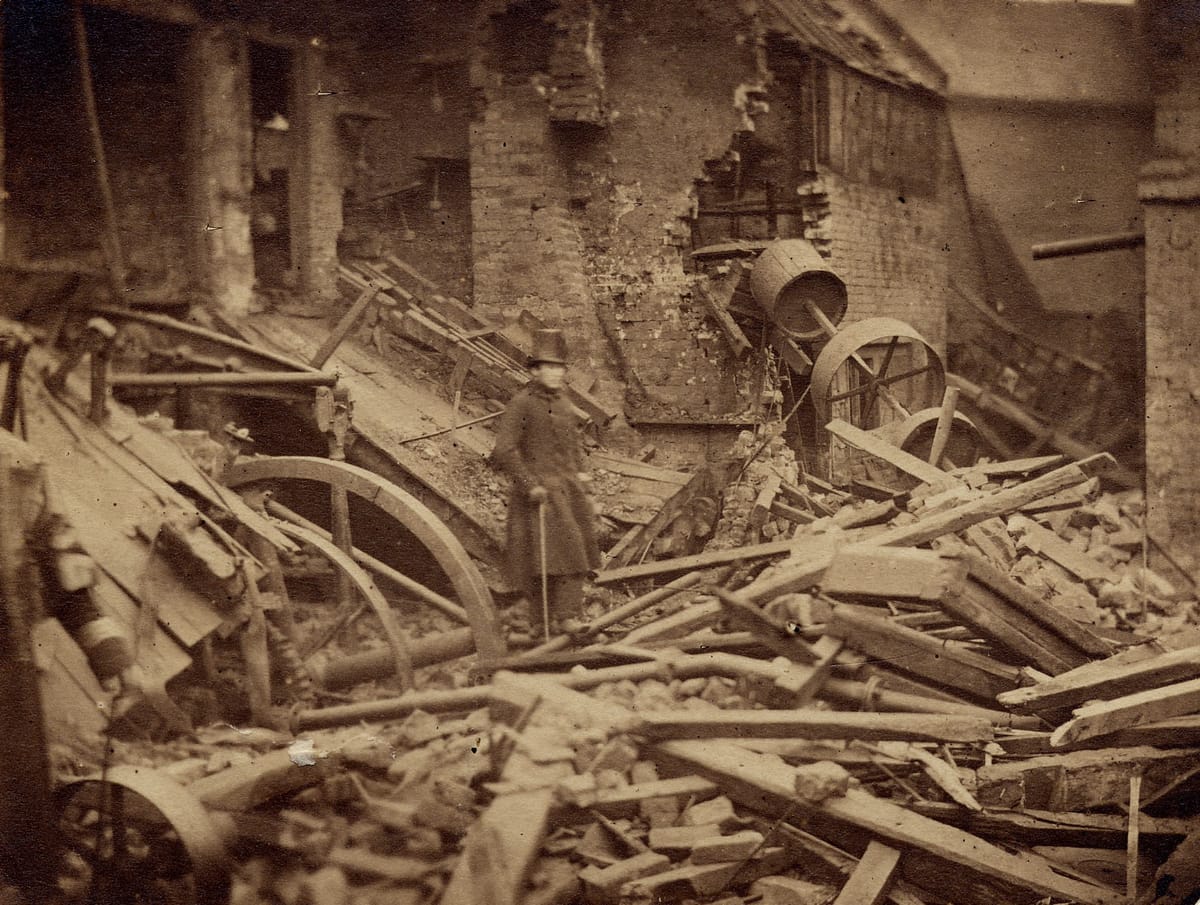
Six years prior to the explosion, the community of Walsall Street, Wolverhampton, stopped to watch the arrival of a steam engine and boiler, to be installed at Benjamin Mason's workshop.
For the first time, machines could be powered by steam. Power beyond all dreams had arrived, nestled amongst the alehouse, the church, the cattle market, and the neighbouring homes. And the community was right to be excited and hopeful. The future had arrived.
Mason made fire-irons – items adorning fireplaces, used to tend open fires. Machinery, old and new, could now be steam-driven, and Mason’s artisans could focus on their art, unlimited by their strength and endurance.[1]
It's hard to put ourselves in that time, except to say, life was often brutal and short. We owe a lot to those who came before us – those who took great risks on our behalf. But risk management of horses was quite different from steam ‘horsepower’. Perhaps compassion, rather than judgement, is the best lens for what was about to occur.
On Friday afternoon, 24 April, 1857, the unthinkable happened. An explosion so great that people almost a kilometre away felt the earth shake. And to paraphrase the saying, those closest to the boiler didn't really die of anything in the traditional sense. They just stopped being biology and started being physics.[2]
Debris rained down across the neighbourhood, reaching as far as St George's Church and Bilston Street. The following Sunday, people met in front of the cattle market and held space for themselves, and those they once loved.
By this time, Benjamin Mason senior had retired. Benjamin Mason junior – no doubt skilled at blacksmithing, hand-driven grinders, and foot-driven lathes – was now managing the workshop.
The coroner's jury met at the Blue Ball Inn. Its principal finding was that Mason junior, since elevated to steam engineer, failed to operate the boiler correctly. They condemned what they called “the dangerous practice of allowing unqualified persons to have the management of engines and boilers.”[3] Other accounts also note the second-hand boiler had been significantly modified during its life.
Sadly, there was nothing exceptional about this explosion, or its terrible consequences. It was reported in the British Parliament that in that decade there were 248 boiler explosions, 486 fatalities and 588 injuries. These numbers were to double in the following decade, before eventually declining.[4][5]
• • •
Like AI, the transformative power of steam escaped those early inventor's workshops, unstoppable in its adoption. Not all boilers exploded, but the risks shaped a generation. If the steam-age metaphor holds, what lessons will shape ours?
References
Bev Parker, Wolverhampton History & Heritage, archived at Wayback Machine⧉. ↩︎
u/blitzkraft (2016). What-If 141: Sunbeam. r/xkcd. ↩︎
"Boiler Explosion at Wolverhampton". London Illustrated News, 2 May 1857, p.2(400), p.12(410). Available at Internet Archive⧉. ↩︎
Bartrip, P. W. J. (1980). The State and the Steam-Boiler in Nineteenth-Century Britain. International Review of Social History, 25(1), 77–105. Cambridge University Press⧉. ↩︎
Great Britain. Parliament. House of Commons. (1870). Report from the Select Committee on Steam Boiler Explosions. In Reports from Committees (Vol. 10). Available via Google Books⧉. ↩︎