FHIR Encounters: A practical overview
This brief overview describes the HL7 FHIR Encounter and why it's an important tool in health informatics.

Introduction
There's a considerable amount of technical literature discussing the FHIR Encounter but little to support healthcare leaders considering encounters from a more strategic perspective.
In this brief overview I'll talk about what an Encounter is and what data it can contain. I'll then cover potential uses of encounter data, and close by offering a few considerations for leaders considering implementing Encounters in the New Zealand context.
But first, what is FHIR?
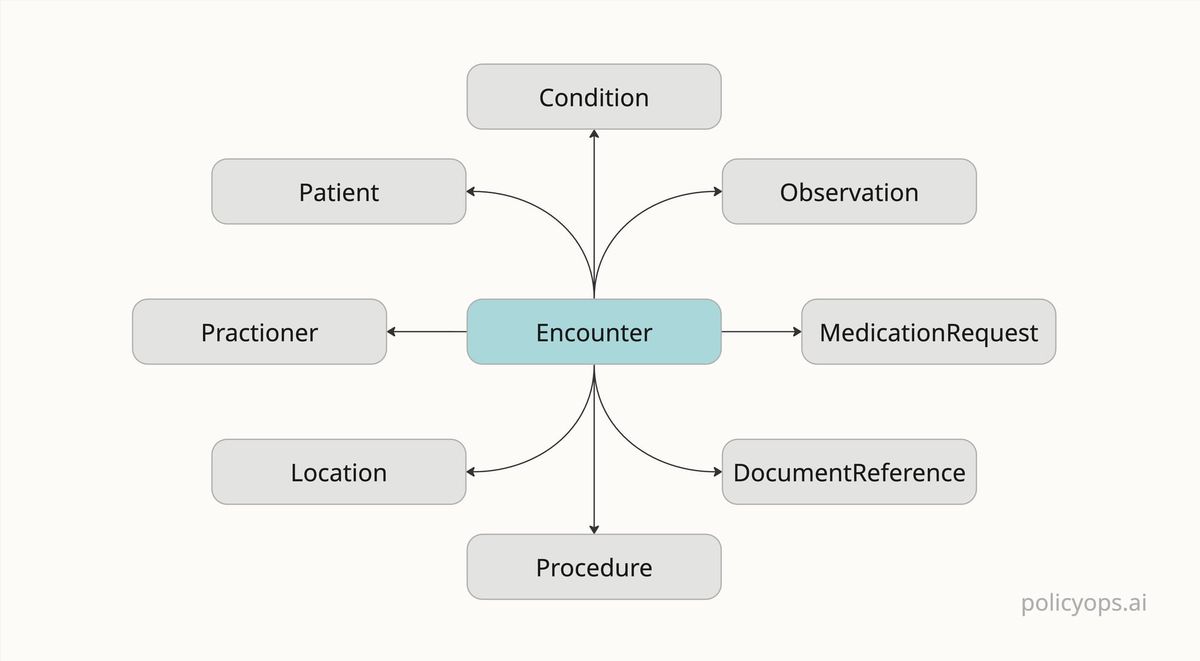
FHIR stands for Fast Health Interoperability Resources and it's a set of HL7 standards for exchanging health data. FHIR includes around 150 predefined data structures, known as resources, that cover a range of healthcare topics. Encounter is one of these resources. FHIR resources are like building blocks – they can be combined and linked to meet a wide range of health data requirements.
What is an Encounter?
If you’ve ever sat in a room with a healthcare professional or had a virtual consultation to receive care or assess your health, you’ve had a "healthcare encounter”.
In everyday life people might refer to going to ED, attending an appointment with their GP, or visiting their Dentist. "Encounter" is just an umbrella term for a variety of familiar real-world healthcare experiences.
FHIR defines an encounter as:
An interaction between a patient and healthcare provider(s) for the purpose of providing healthcare service(s) or assessing the health status of a patient.
Source: https://hl7.org/fhir/encounter.html
So from FHIR's perspective an encounter's characteristics are:
- There's at least one patient and one healthcare provider involved.
- There's an identifiable interaction between the patient and the healthcare provider(s).
- The interaction is for the purpose of receiving care or assessment (i.e. purely administrative events are excluded).
There is no requirement that the patient and provider are at the same location, so virtual encounters can be included.
While not stated in the definition, a FHIR Encounter can contain details of others involved such as family and whānau, care givers and others.
What can a FHIR Encounter contain?
The Encounter mainly focuses on outlining the nature of the healthcare interaction and it can be linked to other FHIR resources for more detail when needed. For example, if the encounter includes a prescription, a FHIR MedicationRequest can be linked to the Encounter.
At its core, an Encounter will usually include things like:
- Who was involved (the patient, clinician(s), and perhaps family, whānau and others in attendance)
- What the encounter was about (the purpose or focus of care)
- When it occurred (date, time, and duration)
- Where it occurred (if in-person)
- The service provider/organisation providing the care
- How care was delivered (e.g. in-person/virtual)
The full set of current R5 FHIR Encounter data items is listed here.
For those wanting to see Encounter data in JSON format, a simple example is available here.
The flexibility within the standard
Encounters can as simple as a walk-in flu vaccination at a pharmacy and as complex as an ED presentation or inpatient stay. Besides some core requirements, the standard allows implementers to take the 'Base Encounter', and select the data items that are relevant and required for a specific implementation. Those requirements are then published in an Implementation Guide or 'IG' that parties to the data exchange agree to.
This flexibility is a feature not a bug – but it should be approached with caution. From a national perspective several things need to be in place to ensure that each individual project attends to a common set of carefully governed national patterns.
The value of Encounters
High quality Encounter data can be an asset to both patients and the sector as a whole. Here are just some of the ways it can provide value.
Providing context
Health data often focuses on facts: medications, allergies, conditions, observations, and so on. In some settings encounter information can enrich the significance of those facts by providing context. For example, a medication prescribed during a routine primary care encounter has a different context than one prescribed during an ED encounter.
Longitudinal records
Patients may consider encounters part of their personal health story – the urgent care visit, followed by an ED presentation, followed by an admission for example. This makes an 'encounter view' of their data potentially useful for them and their caregivers.
Clinicians may wish to view the patient's recent healthcare encounters to better understand what's going on for them, and how they are being supported from a continuity of care perspective.
In the New Zealand context, many encounters form part of agreed clinical pathways or HealthPathways that guide assessment, management and referral decisions. Encounters can contribute to a picture of a patient’s overall care journey within a pathway.
Health system stewardship also benefits from understanding the broader patterns in patient journeys at the aggregate level. Encounter data is raw material for understanding patient flows across service types.
Service utilisation & planning
Encounter data enables those commissioning services to better understand service pressures right now, along with the impacts of investment, policy, and other changes over time.
Claims & funding data
Encounters provide supporting information for individual claims as well as volume information for volume-based funding arrangements.
Health research
Public health and other forms of research require high quality data. With carefully governed data quality, Encounters can provide important inputs into understanding population health and the broader impacts of health policy.
What's next for Encounters in NZ?
Implementing Encounters at scale in Aotearoa will require deliberate national coordination. Here are a few strategic considerations for healthcare leaders as NZ moves forward with its Encounter implementations.
Establishing an NZ Base Encounter
A simple initial NZ Base Encounter will provide important navigational and tooling support to implementers. There's an opportunity to contribute to this development through HL7 NZ.
Coordination across standards bodies
Implementation of Encounters will be greatly supported by close alignment across HL7 NZ, HISO, and NZ Core Data for Interoperability.
Integrated governance approach
FHIR Encounters span many governance interests such as: clinical, privacy, standards, data governance, architecture, and security. An integrated governance approach is essential to ensure that key considerations don't fall 'between' governance interests.
• • •
About the author
I enjoy helping healthcare leaders connect policy and strategy to what travels 'down the wire'.
I began my standards journey coding HL7 v2 integrations and later traveled to Sydney to gain HL7 Clinical Document Architecture certification. I've also been fortunate to sit alongside some of NZ's leading health data standards experts on the board of HL7 New Zealand for a time.
If you would like to talk more about Encounters, or health data in general, please feel free to connect with me via LinkedIn, or drop me a message using the contact form.